There’s a lot of talk about the SaaS-pocalypse, and for good reason. LLMs write good code now, and that has to be disruptive. But how?
My impression is that there’s a fair bit of underpants-gnoming going on (Step 1. Do X Step 2. ??? Step 3. Profit). Yes, software production has become massively cheaper, but I haven’t seen any clear descriptions of how this cheap-ness is going to diffuse into the world.
This is good for SaaS companies: since it isn’t yet observable, and it isn’t easily explainable, maybe it won’t happen?
SaaS applications become commodity code
I have a specific hypothesis for how SaaS dies:
Cheap standard applications which ship with the code suck the margin out of the software side, leaving it in the services side.
What’s going to happen is that for the major categories of well-understood software - like ERP and CRM - there will be alternatives that are:
- Built with AI to reach high feature coverage in a short time
- Depend on well-known, proven open source components
- Ship with source code that you can evaluate and extend with AI
- Run wherever you prefer, whether on-prem or in someone’s cloud
- Cheap: Perpetual licences for hundreds of dollars
- Supported by a network of local IT providers with AI-assisted tools
The argument is not that these solutions will be powerful or feature-differentiated. Rather, I expect them to be distinctly average - good solutions for 80% of businesses - and almost entirely un-innovative. They will be re-implementations of known solutions to known problems.
But they will be better simply because (a) they are more affordable and (b) you can build on them. In addition, there’s a bunch of complexity that is removed from the product experience:
- There’s no big upfront commitment: download it, try it out, buy a licence if you like it. (Throwback: I grew up with mail-order shareware catalogues!)
- There’s no fancy licensing model (“community” vs “enterprise”) - you own it. All of it.
- The architecture is clean and simple because (and so that) anyone can extend it by writing code.
These applications will be just the essence of what is needed, uncomplicated by externalities from business models and market strategies.
Buy my ERP
ERP is a great example here. Well known problem; well known solutions. It’s not rocket science. Yet, I’ve talked to a bunch of people who are running or building companies, and it is a painful subject. They have to choose between:
- Spend priceless bandwidth building from scratch (which, even with AI, takes time and focus); or
- Adopt something that is a mediocre fit with their business and which they know will start to grate over time.
If you can start with something that covers all of the basics, and spend your time only on the customisation, the ROI is a no-brainer.
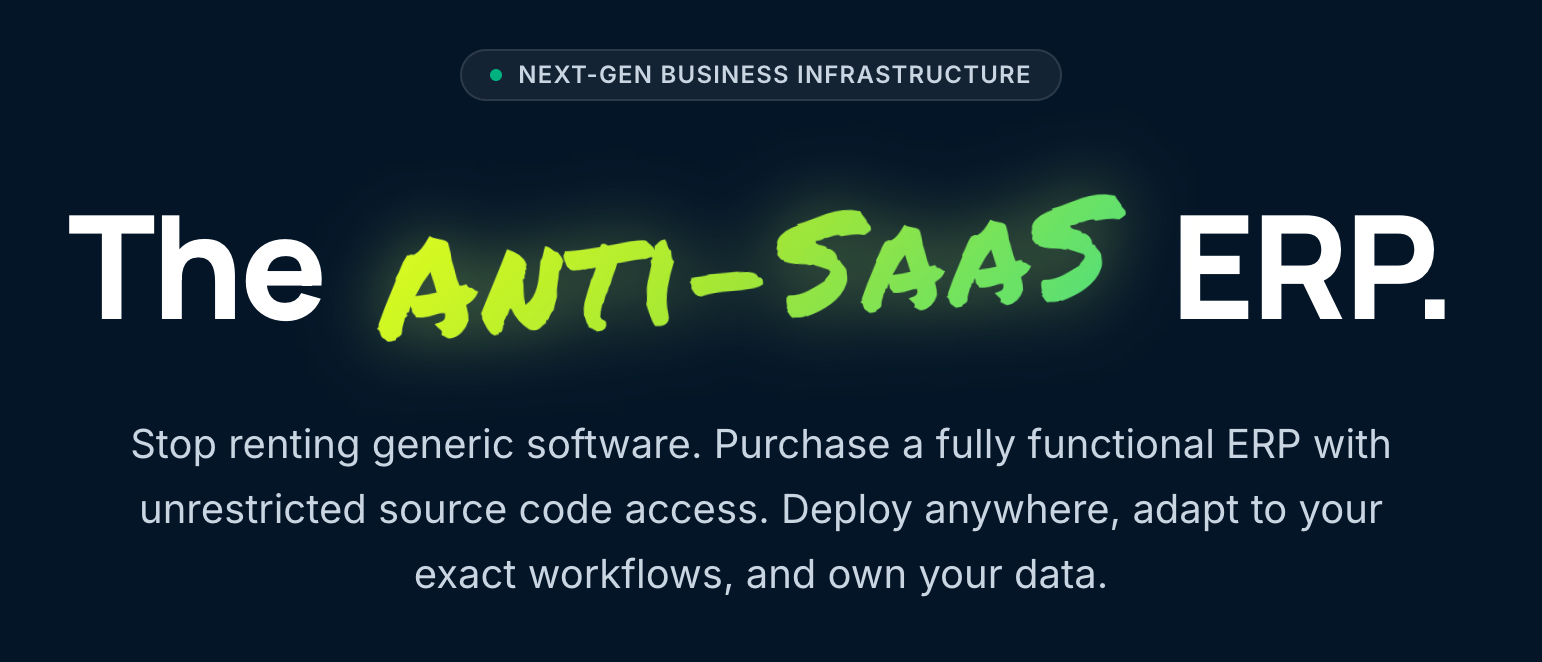
I’ve built one for ERP. You aren’t going to use this (today) if you’re a big company, but if you’re a small one - especially a new one - then I can’t see why you wouldn’t. You can see it (and try it) here: herobm.com.
What about OSS?
OSS has a lot of these characteristics already. What I’m doing with HeroBM looks a lot like OSS, other than that (a) you have to buy a licence and (b) you can’t contribute code back.
These differences are important. The licence provides commercial incentives for continued investment and the construction of a win-win ecosystem, such as partnerships with local providers (who sell licences and support deployments). The idea that this could be my day job got me started, and will get many others started as well.
Ruling out contributions of code from multiple parties gives complete control to a company that can direct the evolution of the product. OSS projects are also struggling with AI-generated contributions. In the end, if code is cheap, the coordination cost of farming out development to a community simply may not make sense any more. One person with a clear idea of what they want to build can move incredibly fast nowadays.
In the last two decades there have been a lot of companies that have been built on an OSS core, which - as they grow - tends to become less and less open. A sell-the-code model is a much cleaner implementation of the same core strategy.
Existing OSS products could pivot towards this model. I suspect that those that are big will struggle to pivot their ecosystems, but some may make the jump. Great - the emergence of this model is a Good Thing.
The economist and the software developer
The implication of this for CRM and ERP type SaaS companies is clear (and painful): your software margins are going away. People will buy perpetual licences for the same price as your annual (or even monthly) fee, and direct money towards customisation and support. There will be at least equivalent spend (everyone loves a good Jevons’ paradox these days) but the margin will be services margin, not software margin.
This is very good for most of the world. Most companies are not software companies. In an economic sense, they have been paying a high price for one specific type of business input - code - due to scarcity. That scarcity has gone away, so the price of that input falls, and there will be windfalls downstream. Whether the wind falls to the buyers or sellers will depend on each market.
More personally, I’m excited to see software-development-as-a-job diffuse out into local communities. There are lots of small businesses that could be a lot more effective and efficient if their software just worked a bit better for them. And there are lots of technical people who would love to live in smaller communities and work with these businesses. Unfortunately, up until now the labour of software development has been highly concentrated in a few big cities, with highly specialised experts.
AI-assisted coding will be transformative on this front, for two reasons:
- The wave of applications that ship with source code will empower these local software developers to deliver solutions to local companies that they simply couldn’t have achieved on their own.
- With AI assistance, anyone with a decent understanding of software can work on any aspect of the system. As long as you are technically “conversational”, the agent can help you get what you need done. This enables small players to cover the full stack.
Let’s get specific: Salesforce is dead
Of course, not all SaaS is dead. If you have unique technology - a so-called “golden gear” - you can use that to pull people into your SaaS. Fair enough, SaaS is a good way to deliver technology. But if you don’t have a golden gear, you are in trouble.
Salesforce was an amazing company. They built an ecosystem and an empire on top of a web-based CRM, with network effects from distributing a consistent data model. They made it possible to implement all kinds of business processes in software without having to see or write any code. And all you had to do was pay them heaps of money, and even more next year, and never leave.
Today, I don’t see anything defensible in Salesforce’s business. There will be no reason to buy into this pact at the bottom end, and there are strong (dollar-shaped) incentives to get out in the middle. The top will take some time, but it will also go eventually, once the ecosystem has matured around these new solutions.
I will not get rich
Clearly, anyone can do what I am doing. The tools are widely available, and I don’t have any unique knowledge in this space. Over time, my margins will tend towards zero. This is not a VC-backable unicorn rocket ship. It is, from an investment point of view, a donkey.
I’m OK with that. I’m excited about the idea of having a front row seat in the emergence of a new software business model, and seeing the benefits flow into the businesses and local software developers. I like donkeys.